Hangzhou Travel Guide: Why This Is More Than a Shanghai Day Trip
West Lake is at its best at dawn and dusk — exactly when the day-trippers have gone. Two days in Hangzhou, plus tea hills, temples and how to time the crowds.
Plan at a glance
- Best time
- March–May & September–November
- Suggested stay
- 2 days
- Region
- East China
- Visa shortcut
- Most nationalities can enter visa-free for up to 240 hours in transit — see the guide
Most visitors see Hangzhou as a day trip from Shanghai: arrive late morning, circle West Lake, leave before dinner. It works. It also means you see the lake at exactly its worst — busy, flat-lit and mid-afternoon.
West Lake has two genuinely great hours, and a day trip catches neither.
The case for staying
| Time | What you get | Day-tripper access |
|---|---|---|
| 06:00–08:00 | Mist on the water, empty causeways | ✗ (you are still in Shanghai) |
| 08:00–11:00 | Walking pace, thinning crowds | ✓ |
| 11:00–16:00 | Peak crowds, flat light | ✓ ← most day trips land here |
| 17:00–19:00 | Golden light, locals out walking | ✗ (last trains pulled you away) |
| After dark | Illuminated causeways, quiet | ✗ |
The lake is a UNESCO site for its cultural landscape — its composition, its causeways, its association with a thousand years of poetry. That landscape was designed to be seen in soft light and low crowds. Midday is not when it makes its case.
Day 1 — West Lake, done properly
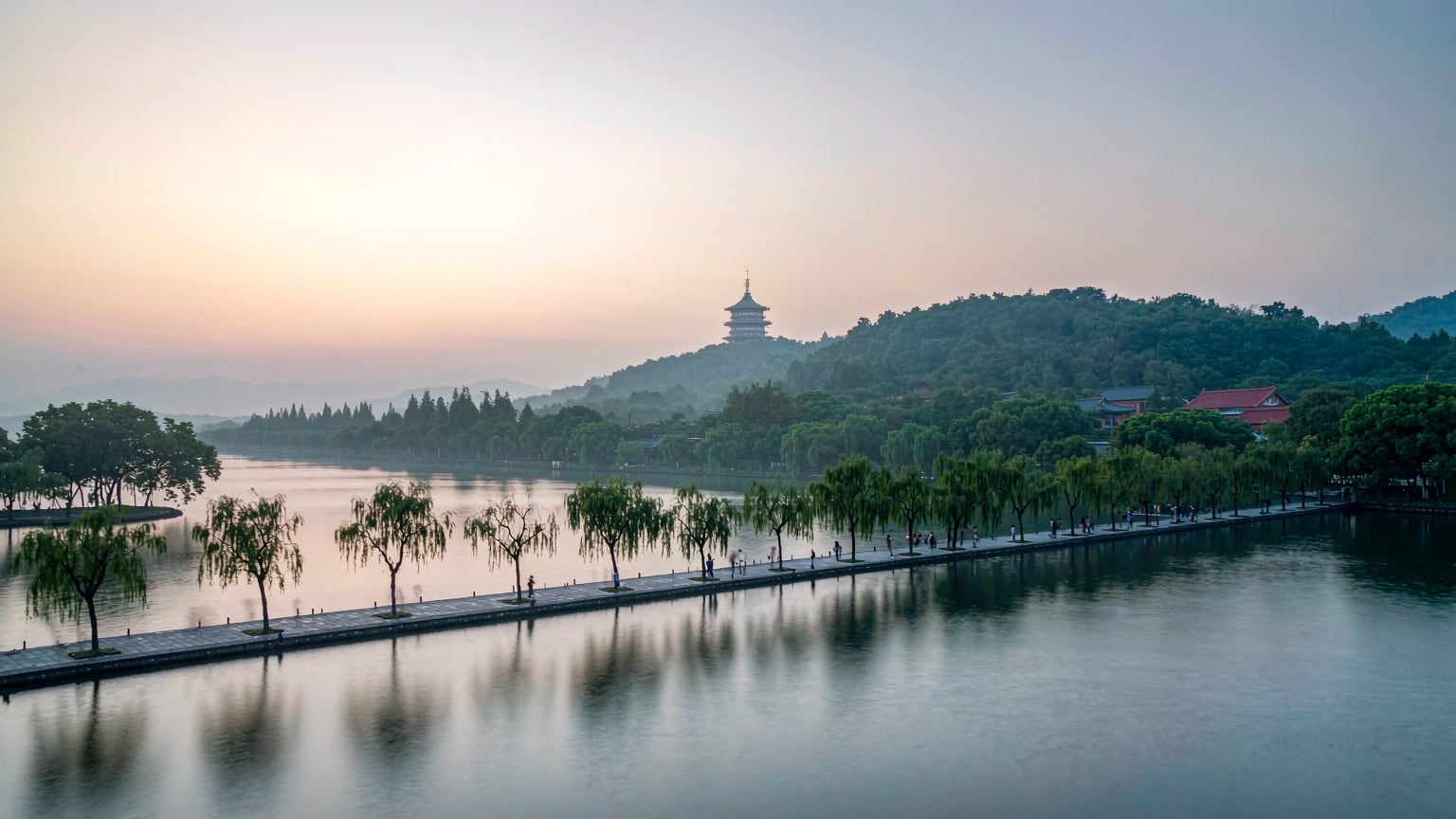
Start at 06:30. This is not an exaggeration. Before 8am the causeways belong to joggers and tai chi groups, the water is still, and the pagodas sit in mist.
- Su Causeway (苏堤) — the 2.8 km north–south walk. Cross it early, in either direction.
- Boat to Three Pools Mirroring the Moon (三潭印月) — the island with the pagodas on the back of the ¥1 note. Hand-rowed boats are slower and quieter than the ferries.
- Broken Bridge (断桥) — at the lake’s north-east corner. Famous, and genuinely lovely at dawn — chaotic by 10:00.
- Leifeng Pagoda (雷峰塔) — climb it late afternoon for the best light over the lake. It is a modern reconstruction, but the view is the real reason to go.
Lunch on Hefang Street (河坊街) — the restored Southern Song imperial street, a short taxi from the lake’s east side. Tourist-oriented but good for snacks, and the adjacent Southern Song Imperial Kiln Museum is a quiet, well-made stop.
Day 2 — The tea hills and the temple
This is the half of Hangzhou that most day-trippers miss entirely, and for many people it is the better half.
Morning: Longjing tea country. The terraced tea fields around Meijiawu and Longjing Village, 20–30 minutes from the lake.
- Walk the fields on the marked paths — free, and far quieter than the lakeside.
- Buy tea from a farmhouse, and taste before you buy. Prices vary enormously and quality does not always track price.
- The China National Tea Museum is nearby and free, with good English labelling.
Afternoon: Lingyin Temple (灵隐寺) and Feilai Feng (飞来峰).
- The temple is one of the wealthiest and most important Buddhist sites in China.
- Feilai Feng is the real prize — hundreds of rock-cut Buddhist carvings from the 10th to 14th centuries, in the grottoes and cliffs beside the temple.
- Go after 14:00 to avoid the tour groups.
Evening: the Grand Canal. Walk the stretch around Gongchen Bridge (拱宸桥), the southern terminus of the Beijing–Hangzhou canal. Working-class, lived-in and a good contrast to the polished lakefront.
What to eat
Hangzhou cuisine is mild, faintly sweet and gentle — a deliberate contrast to Sichuan.
- Dongpo pork (东坡肉) — slow-braised pork belly, the city’s signature dish.
- West Lake vinegar fish — freshwater fish in a sweet-sour sauce.
- Longjing shrimp — shrimp stir-fried with the local green tea leaves.
- Beggar’s chicken — clay-baked, usually ordered in advance.
- Longjing tea itself — the reason the hills exist.
Getting there and around
- High-speed rail: Shanghai Hongqiao to Hangzhou East in 45–60 minutes, very frequent. There are three Hangzhou stations — check which one your ticket names.
- Within the city: the metro is fast and cheap. West Lake’s east side is looped by buses, but expect heavy traffic on lakeside roads at weekends.
- Bikes and e-bikes are the best way to move along the lake’s edge. Rental is widely available and the lakeside paths are purpose-built for it.
- From the airport: Xiaoshan (HGH) connects to the metro, roughly 45 minutes to the lake area.
Where Hangzhou fits in your trip
Hangzhou is the standard day trip from Shanghai — but two nights here, with the lake at dawn and the tea hills in the morning, is a different experience from the day-trip version.
It fits three ways: as a two-night stop between Shanghai and the south, as a one-night add-on if you are based in Shanghai, or as a day trip if your schedule is genuinely tight — though in that case, prioritise the tea hills over circling the lake.
The rail connection makes any of these easy. Confirm your entry eligibility first, then check the best-time guide for how the season affects the lake.
Frequently asked questions
Is Hangzhou worth staying overnight?
Yes. West Lake is at its most atmospheric before 8am and after sunset, and those are precisely the hours a Shanghai day trip cannot cover. Staying one or two nights gives you the lake at its best and time for the tea hills, which most day-trippers skip entirely.
How do I get from Shanghai to Hangzhou?
High-speed rail from Shanghai Hongqiao to Hangzhou East takes 45–60 minutes with frequent departures. Book with your passport as usual — see our high-speed rail guide for the mechanics.
How many days do you need in Hangzhou?
Two days is a good balance: one for West Lake done properly, one for the tea hills, Lingyin Temple and the old streets. One day works if you focus only on the lake — three days lets you add Xixi Wetland or a Grand Canal walk.
When is the best time to visit Hangzhou?
Late March to May, and September to November. Spring brings blossom and the famous misty lake views — autumn is clear and dry. Avoid the National Day golden week in early October, when the lakeside paths become genuinely hard to walk.