Chongqing Travel Guide: The City Where Navigation Is the Challenge
A vertical city where the ground floor is on the 22nd storey. How to read Chongqing's levels, what to see, and why the hotpot here is the original.
Plan at a glance
- Best time
- March–April & October–November
- Suggested stay
- 2–3 days
- Region
- Southwest China
- Visa shortcut
- Most nationalities can enter visa-free for up to 240 hours in transit — see the guide
Chongqing breaks the mental model most visitors arrive with. It is not a city laid out on a grid, and it is not a city laid out in rings. It is built on steep hills between two rivers, which means it grew upwards in layers instead of outwards.
The practical consequence: your map app will fail you.
Why navigation here is different
In most cities, an address tells you where something is. In Chongqing, an address is incomplete — you also need to know which level.
- A building’s “ground floor” may be the 22nd storey, because the hill on one side rises that far. Enter from the other side and you are on floor 1.
- The metro sometimes runs through residential blocks. Liziba station is the famous case — the train passes through the 6th to 8th floors of an apartment building.
- Walking routes on map apps frequently route you along roads that pass over your destination, with no indication that your target is 40 metres below.
What actually works — use the metro to get to the right district, then ask. Locals navigate by landmarks and levels, not coordinates. Failing that, follow the crowd — foot traffic in Chongqing is a better routing signal than any app.
Build in extra time for the first day. Everyone loses 30–60 minutes to a wrong-level mistake. Once you internalise the vertical logic, the city becomes far easier than it looks.
The non-negotiables
1. Hongya Cave (Hongyadong), after dark
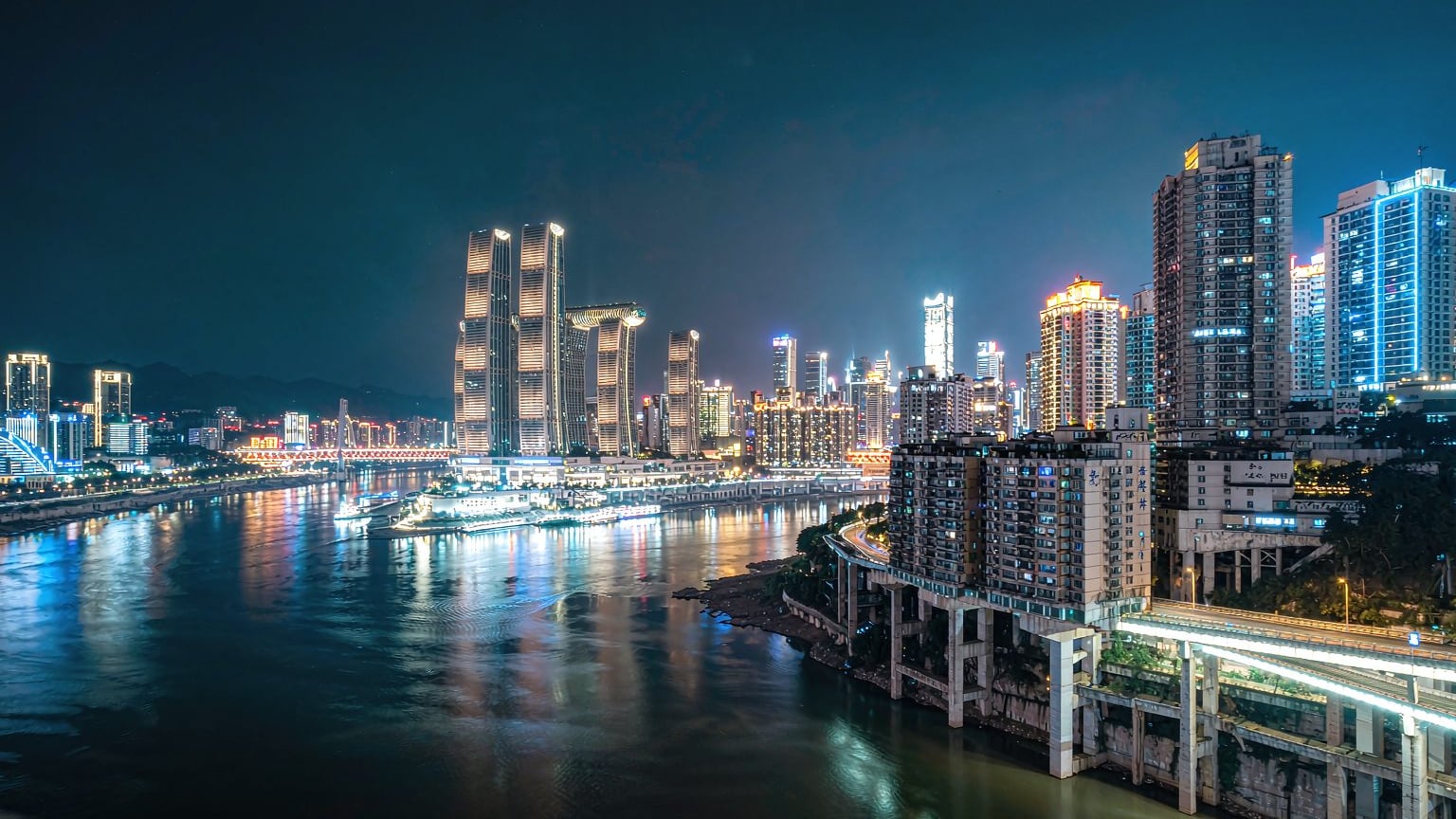
The stilted building complex on the Jialing River, lit up at night — the image most people recognise as Chongqing.
- Go for the lights, roughly 19:30–22:00.
- View it from the Qiansimen Bridge, not from inside the complex itself.
- Expect crowds on the bridge at weekends.
2. Liziba metro station
The train-through-a-building spectacle. It takes ten minutes and it is genuinely odd.
- Take metro Line 2 to Liziba — the station is signed in English.
- The viewing platform is outside the station, on the street level below.
- Combine it with a ride along Line 2 — it is an elevated route with good river views.
3. The Yangtze River cable car
A working commuter crossing that doubles as the best cheap view in the city — around ¥2.
- Crosses the Yangtze between Yuzhong and Nan’an.
- Go at dusk for the skyline lighting up.
- It is a commuter service, so it gets busy at rush hour.
4. Ciqikou old town
A restored Qing-era river port quarter on the Jialing’s west bank — steep lanes, teahouses, snack stalls.
- Go early, before 10:00, while it is still calm.
- Genuinely good for street food, unlike some restored quarters.
What to eat
Chongqing is where hotpot comes from, and the local version is not the same dish served elsewhere.
| Dish | What it is | Heat |
|---|---|---|
| Chongqing hotpot | Fiery beef-tallow broth, bubbling at the table | Very high |
| Xiaomian (小面) | Street noodles with chilli oil — the city’s breakfast | High |
| Suanlafen (酸辣粉) | Sour-spicy sweet potato noodles | Medium |
| Maoxuewang | Duck blood curd, tripe and offal in chilli broth | High |
| Shancheng tangyuan | Sweet glutinous rice balls | None |
Ask for 微辣 (wēi là, mild) and mean it. The default here is hotter than Chengdu’s. The sesame-oil and garlic dipping sauce is not optional — it is what makes the heat workable.
Getting there and around
- High-speed rail: ~1.5 hours from Chengdu, ~4.5 from Xi’an. The main stations are Chongqing North and Chongqing West — check which one your ticket uses.
- Flights: Jiangbei International (CKG) has broad domestic coverage.
- Metro: extensive, cheap, and the most reliable way to move given the road geography.
- Taxis and Didi work, but drivers may stop on a different level than your destination — confirm the level when you get in.
Where Chongqing fits in your trip
Chongqing is the natural next stop after Chengdu — 1.5 hours by rail, and a deliberate contrast. Chengdu is flat, relaxed and tea-house paced. Chongqing is vertical, loud and relentlessly energetic.
Two nights is the right length. Add a third if you want the Dazu Rock Carvings, or if you are starting a Yangtze cruise through the Three Gorges — Chongqing is the main departure point.
For most first trips, it slots in as the western anchor: Beijing → Xi’an → Chengdu → Chongqing, then fly out. See the 10-day itinerary for how the timings work.
Frequently asked questions
Is Chongqing worth visiting?
Yes, if you want a Chinese city that does not look or feel like any other. The vertical geography, the rivers, the night skyline and the hotpot culture are genuinely distinctive. It pairs naturally with Chengdu — about 1.5 hours away by high-speed rail.
Why is Chongqing so hard to navigate?
Because it is built on steep hills between two rivers, so the city developed in layers rather than outwards. Roads stack, buildings have multiple ground-level entrances, and pedestrian routes involve stairs, lifts and elevated walkways that map apps do not model.
How many days do you need in Chongqing?
Two nights covers the central sights comfortably. A third day opens up the Dazu Rock Carvings, or positions you to start a Yangtze River cruise through the Three Gorges.
When should I avoid Chongqing?
July and August. Chongqing is one of China's "furnace cities" — summer heat and humidity are genuinely punishing. Late autumn and spring are far more comfortable.