Temple Etiquette in China: What to Do, and When to Stay Out
Visiting Chinese temples and religious sites without being the tourist everyone photographs — dress, thresholds, incense, photography rules and the places you should not enter.
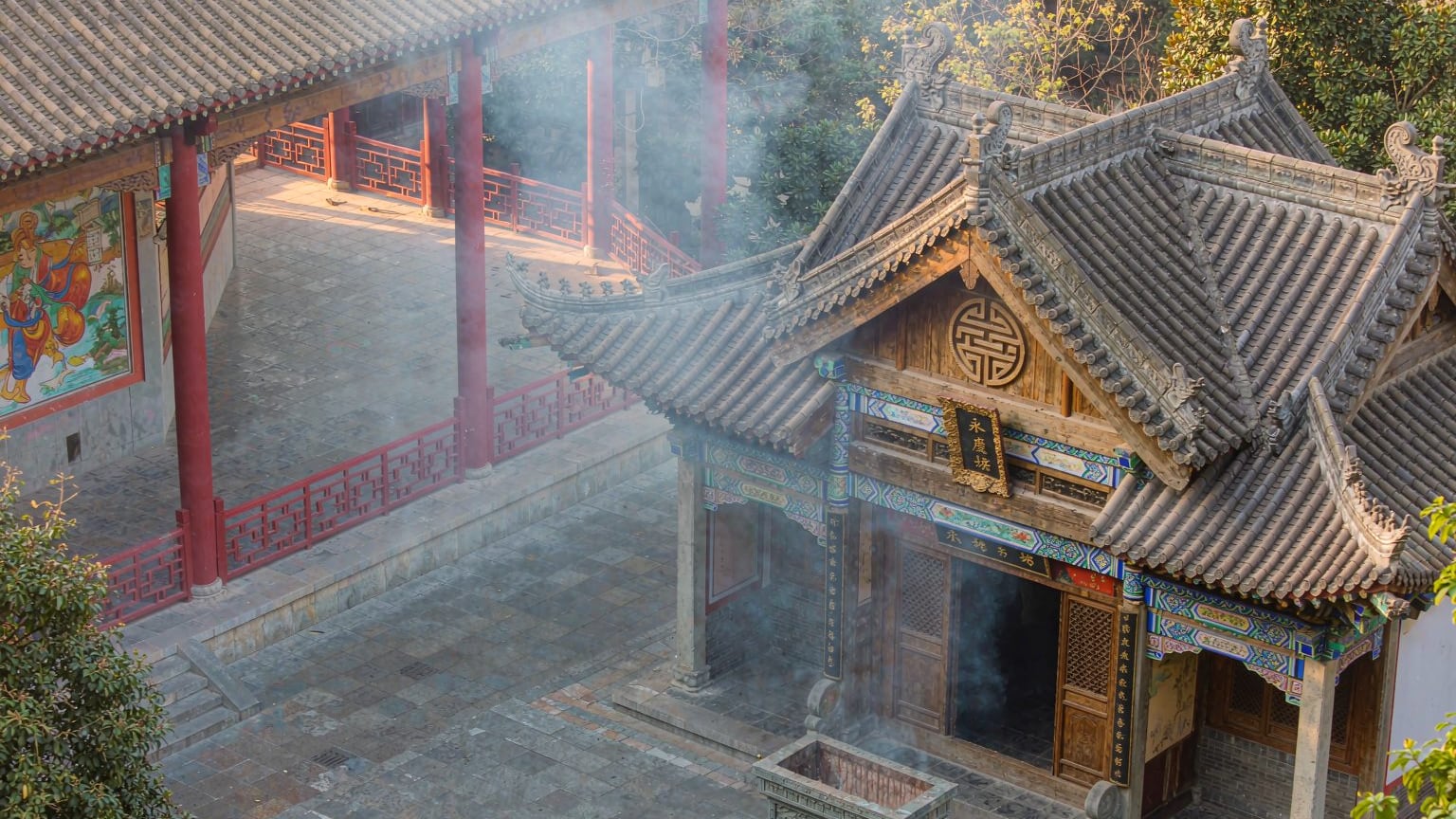
China’s temples are working buildings, not museums. That single fact answers most etiquette questions: behave as you would in an active church, and you are almost certainly fine.
The rest is a short list of physical rules, and one distinction that matters — a temple that functions as a site of pilgrimage is not the same as a reconstructed tourist attraction.
The threshold rule
Every hall has a raised wooden or stone threshold. Step over it. Do not stand on it.
This is the rule visitors break most, usually without noticing. It is understood as both a practical respect (the threshold is the boundary of the sacred space) and a superstition about bad luck. Either way, it is the one thing a caretaker will correct you on.
Two more physical courtesies:
- Enter left foot first and exit left foot first at a main gate. With two doors, men traditionally use the left and women the right — nobody enforces this, but it is a nice touch.
- Do not point your feet at a statue, and do not sit with your soles facing one. Feet are the lowest part of you, and pointing them at something sacred reads as disrespect.
Dress
There is no strict dress code at most temples, but the bar is closer to a church than a beach:
- Cover shoulders and knees. This matters most at active religious sites and in Tibetan-influenced temples.
- Remove hats inside a hall.
- Take your shoes off if you see a pile of shoes at the door, which happens at some smaller and Tibetan temples.
Practical note for summer: you will be outdoors on stone for a while. Sun hat on in the courtyard, off in the hall.
Incense
You do not have to participate. Buying incense is a normal offering and also, at larger commercial temples, an upsell — the “free” incense that comes with a blessing is sometimes a donation request dressed up. It is fine to decline.
If you do take incense:
- Light it in the burner provided, not from a candle you brought.
- Hold it with both hands, at chest height.
- Bow three times.
- Place it upright in the burner. Do not blow it out — fan the flame with your hand.
Three sticks is the common offering. More is not better.
Photography: the sign to look for
This is where visitors most often get it wrong, and the rule is simple once you know what to look for.
- Courtyards, architecture, rooflines, incense burners: photograph freely.
- Inside a hall, facing a statue: look for the 禁止拍照 sign — photography prohibited. Where it appears, put the camera away.
- People praying or prostrating: do not photograph them. This is the one that causes real offence, and it happens constantly at Tibetan sites and around temple festivals.
- Monks and nuns: ask first, or don’t. Many will say no.
Nobody wants a flash going off in a dim hall during a service. If you see one being conducted, back out and come back later.
Quieter, active sites
Some sites are pilgrimage destinations rather than attractions. Yonghe Temple in Beijing, Lingyin Temple in Hangzhou, and the Tibetan monasteries are the obvious ones. At these:
- Move slower and quieter.
- Give way to anyone who is clearly there to pray.
- Put the phone away entirely inside halls.
- Expect the atmosphere to be less “attraction” and more “in use”.
Where you should not go
A few areas are plainly off-limits and signed as such:
- Restricted monastic quarters — behind closed doors, often marked 游客止步 (visitors stop here).
- Ordination halls and living quarters.
- Anything locked. Obvious, but visitors open things.
- Tibet-region sites requiring permits — see the visa guide for what needs advance paperwork.
Where this fits
Temples are the most visible cultural sites on a first trip — Beijing’s Temple of Heaven and Lama Temple, Hangzhou’s Lingyin, Xi’an’s Big Wild Goose Pagoda. Read the etiquette piece for the social rules that apply everywhere, and this one before you climb the steps.
Frequently asked questions
Do I have to be religious to enter a Chinese temple?
No. Visitors are welcome at working temples, and many Chinese visitors are there as sightseers too. Behave as you would in a church you were visiting as a tourist — quiet, unhurried, and out of the way of anyone praying.
Can I take photographs inside?
In courtyards and of architecture, almost always yes. Inside halls with statues, look for the 禁止拍照 sign (photography prohibited) and follow it. When in doubt, do not photograph people mid-prayer or any image of a Buddha in a hall.
Is there an entrance fee?
Many working temples are free. Those that are also major tourist sites — the Temple of Heaven, Yonghe Temple in Beijing — charge, typically ¥15–¥45. Big commercial temples sometimes charge separately for incense.
What do I do with the incense?
You do not have to take any. If you do, light it in the provided burner, hold it with both hands, bow three times, and place it in the burner upright. Do not blow it out — fan it with your hand.