Dining Customs in China: How a Shared Meal Actually Works
Ordering, sharing, the lazy Susan, tea refills and who pays — how a Chinese restaurant meal runs, what confuses first-timers, and how to order without a menu you can read.
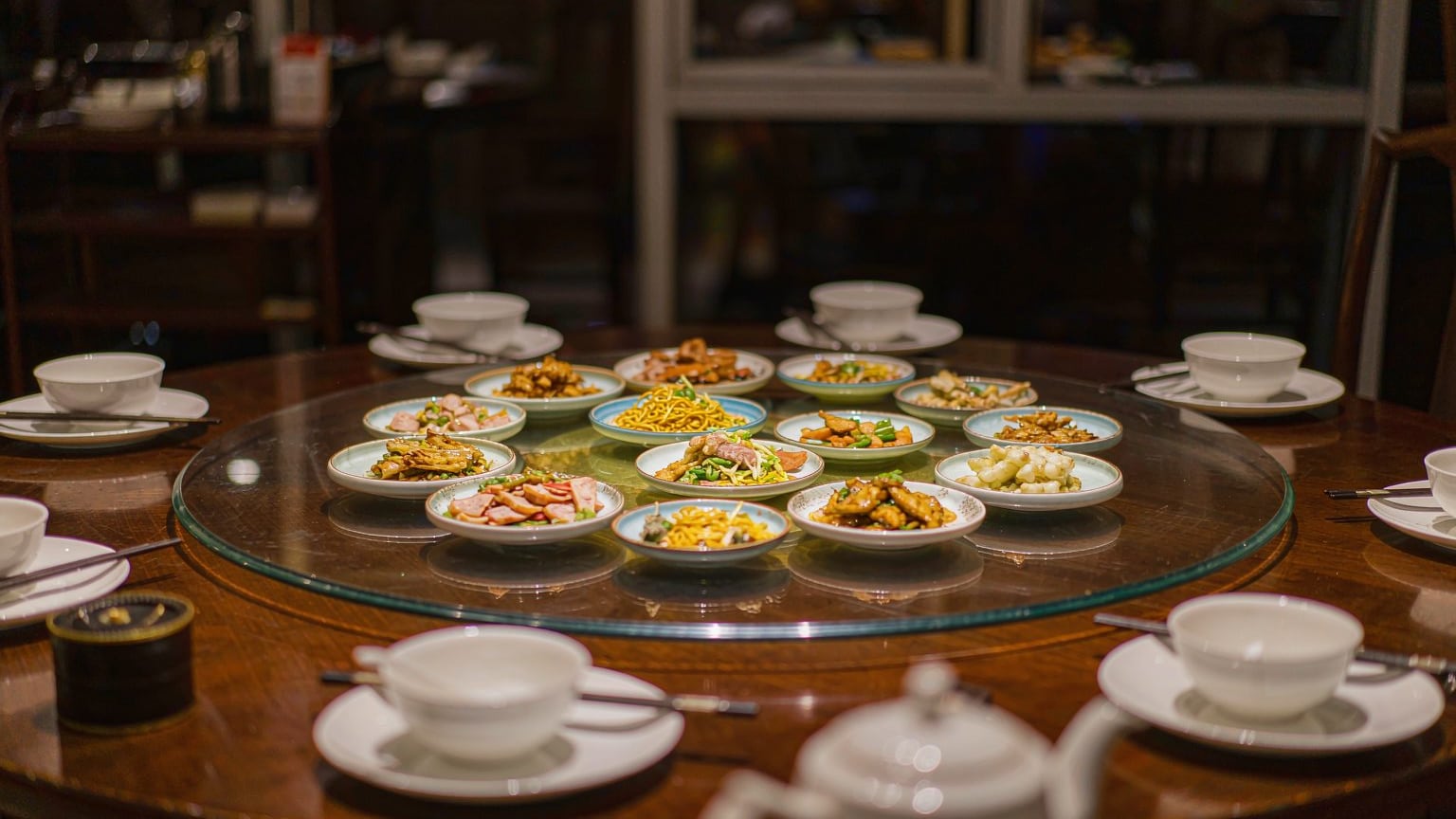
A Chinese restaurant meal has a different logic from a Western one, and it is the source of most first-visit confusion. Nobody gets their own plate of food. The table orders together, the dishes land in the middle, and everyone eats from all of them.
Once that clicks, everything else makes sense.
One table, one set of dishes
There is no “your starter, my main”. Food arrives as a shared set, usually placed on a lazy Susan at bigger tables. You take a portion and pass it on.
A few practical consequences:
- Do not order for yourself. Ordering is a group thing, and someone at the table usually leads it.
- Take from the side nearest you and rotate the turntable rather than reaching across.
- Use the serving spoon if one is provided with a dish. Not every place provides one.
- Take a normal amount first. Loading your bowl before others have taken looks greedy, and there is always more coming.
How much to order
The workable ratio is one dish per person, plus one. Four people, five dishes. Somewhere between six and eight dishes for a banquet table of eight or ten.
Rice, noodles and soup sit outside that count. Order them separately, and order rice per person rather than one bowl for the table.
If you are two people and want to try three things, that is fine — ordering slightly over is much more normal than ordering too little. Running out of food with a guest at the table is the thing hosts actually worry about.
The ordering problem: menus you cannot read
Most mid-range restaurants have pictures. Use them. Where there are no pictures:
- Point the camera at the menu with your translation app set to Chinese. The overlay gives you a rough sense — enough to spot pork, fish or offal.
- Look at the next table. Pointing at someone’s dish and nodding is completely normal.
- Use the three words that matter. Bú là (not spicy), bú yào wèi jīng (no MSG), and zhè ge (this one).
If you have a dietary restriction, say it before ordering, not after the food arrives. Vegetarian food is widely available but is not assumed — a dish with a little pork in it is still “a vegetable dish” in many kitchens.
Tea, water and the refill
Tea is poured for others before yourself, and your cup will be topped up constantly.
- To make the refills stop, leave the cup full. It is the standard non-verbal signal.
- Hot water is the default drink. Restaurants serve it free, and you will be offered it on trains and in waiting rooms. Cold water is a Western habit, not a Chinese one.
- The two-finger tap is the traditional “thank you” when someone pours for you. It is a nice touch, and entirely optional — xiè xie works.
Paying: one bill, one payer
One bill arrives for the table. It is not split, and the fight over who pays is genuine, not performative.
- If you are the guest, let them pay. Insisting causes more friction than it resolves.
- If you want to pay, be quick — settling the bill before the meal ends is the standard move, because it removes the argument.
- Do not tip. Not expected, and it can confuse staff.
For the mechanics of paying day to day — the QR codes, Alipay, WeChat Pay — see the payments guide.
Street food and small shops
The rules relax. At a stall you order one thing, pay by QR code, and eat standing. There is no sharing, no tea service, and no bill.
Two things worth knowing:
- Prices are often on a board above the stall. Point and hold up fingers for quantity.
- Cash is increasingly unwanted. Have Alipay or WeChat Pay set up, or expect occasional awkwardness. See the payments guide.
Where this fits
Dining is where etiquette becomes visible, so pair this with etiquette and taboos if you have not read it. For the food itself — what to order in each city — the destination guides each carry a food section.
Frequently asked questions
Do I order my own dish or does the table share?
The table shares. Ordering is usually a group decision and each dish lands in the middle. Do not treat a dish as yours — take a portion and pass it on.
How much should I order for a group?
Roughly one dish per person plus one, if they are standard size. For four people, five dishes. Rice and soup are ordered separately and are not counted as dishes.
What if I cannot read the menu?
Use the camera function of an offline translation app, or look for pictures — most mid-range places have them. Pointing works. So does following the table next to you.
Is it rude to leave food?
No. Leaving a little is normal and often read as a sign the host ordered generously. Cleaning every plate can signal you were not given enough.
Should I pour tea for myself?
Pour for others first, then yourself — and expect someone to pour for you the moment your cup looks low. The tap-two-fingers gesture is the traditional thank-you, but saying xie xie is perfectly fine.